Monitor · OT Network Monitoring & IDS
An IDS that reads Modbus the way your engineers do.
A write to holding register 40001 is a setpoint change, not a TCP payload. Synaptic OT decodes six OT protocols passively and combines 35 active detection rules with anomaly detection, protocol-compliance checks and CyOTE-based correlation, so an alert always comes with a reason you can check.
Why it matters
Nothing touches the controllers
Synaptic OT only listens on a SPAN port, TAP or PCAP. Active PLC drivers are blocked from the product by an automated code gate, so it can never query or crash a fragile device.
Alerts you can explain to an auditor
Detection is rule-based and repeatable. Each alert states which rule or check fired and why, from a first-seen function code to an ATT&CK for ICS technique.
Tested on real captures
Detection is tested against public ICS attack and reference captures replayed through the product. Baseline anomaly detection covers what no rule anticipates.
protocol_anomaly          HIGH
modbus/tcp  fc=06 write_single_register
src  10.0.0.55  EWS-02      dst  10.0.0.107:502  PLC-07
register  40001  value 4000   baseline 3200–3450
reasons   first_seen_value · off_hours (02:34)
Illustrative values
In the product
See it on screen.
The real Synaptic vSOC interface, running on the built-in demo dataset.
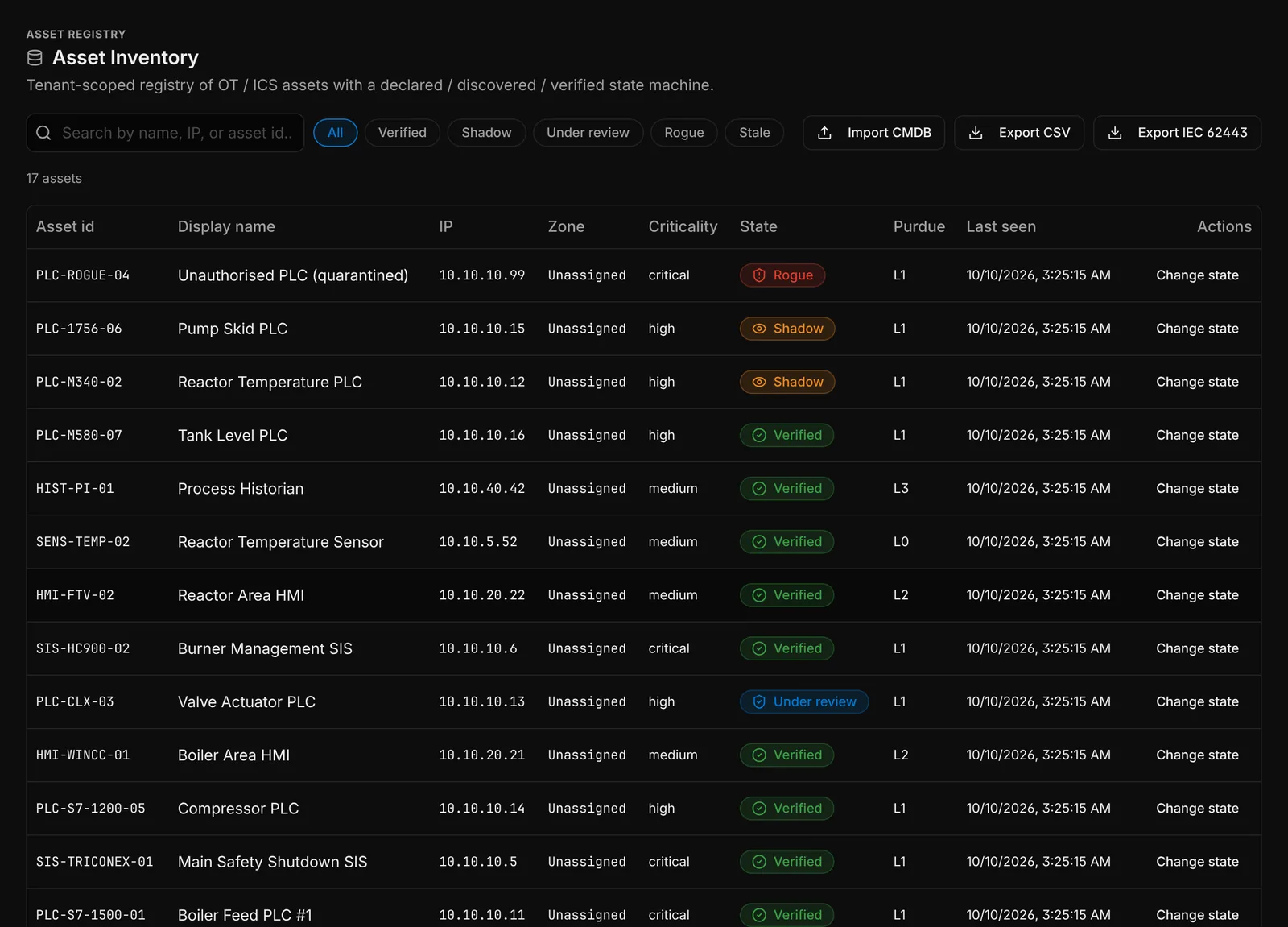
- 1Rogue and shadow assets flagged
- 2Purdue level for every asset
- 3Export the IEC 62443 asset register
Capabilities
What's included
OT Network Monitoring & IDS is part of the full Synaptic OT suite. One licence covers every capability on this site.
Six OT protocols decoded
Modbus TCP (including Schneider UMAS), DNP3, Siemens S7comm, EtherNet/IP and CIP, BACnet/IP and IEC 60870-5-104, decoded down to function codes, objects and registers.
35 active detection rules
OT-specific rules mapped to MITRE ATT&CK for ICS, each with a documented reason and severity that analysts can review.
Protocol anomaly layer
Learns a baseline per protocol, segment and asset, then flags new talkers, first-seen function codes or values, statistical outliers and off-hours activity.
CyOTE-based correlation
Correlates observables using the methodology of CyOTE, the U.S. Department of Energy programme for detecting OT attacks from their observable effects.
Protocol compliance layer
Flags specification violations such as reserved function codes, broadcast writes and unauthorised commands. Documented operational exceptions can be suppressed per asset.
ATT&CK for ICS coverage
A live coverage matrix shows which ICS techniques your detections cover, with export to MITRE ATT&CK Navigator.
Maintenance- and time-aware
Alerts take registered maintenance windows into account, and off-hours checks use each site’s local time, so planned work does not look like an attack.
Questions
Asked by OT and security teams
Does Synaptic OT need agents on PLCs or HMIs?
No. It works entirely from mirrored network traffic (SPAN or TAP) and from project files you upload. Nothing is installed on controllers.
Does it ever send traffic to OT devices?
No. The product contains no active PLC drivers, and an automated check in the build blocks any dependency that would open a connection to a device.
Is AI used to decide what is an attack?
No. Detection is deterministic: rules, anomaly baselines, protocol-compliance checks and correlation. AI is used only afterwards to write a plain-language summary, and it cannot change an alert or its severity.
Works with
See it live, then on your own traffic.
Book a demo with an engineer who built it. When you are ready, request an evaluation licence and run Synaptic OT on a mirror port or a PCAP from your plant, fully offline if you need it to be.